So, picking the best Direct Burial Wire in 2026? It’s not just about grabbing the thickest cable you can find. Things like soil conditions, moisture, voltage drop, how deep you bury it, and what kind of load the circuit needs—they all play a role in how well the wire performs. A cable that’s fine in dry, sandy soil might not do so great in wet clay or places where the ground freezes and thaws a lot. And yeah, that difference really matters.
So, when you're an experienced electrician, you usually start by looking at the load, the distance, and what wiring method is actually approved. After that, it's a matter of comparing things like conductor material, insulation rating, ampacity, and mechanical protection. Copper? Great conductivity, no doubt. Aluminum, on the other hand, can help cut material costs on longer runs. That said, either way you go, you still need the right sizing, terminals that work together, and a careful install. Sure, guidance from manufacturers like Southwire and Cerrowire can definitely help you make a call here. Just don’t let it take the place of local code requirements—or, you know, good professional judgment. At the end of the day, the best choice really comes down to the project itself.
So, this guide is all about the usual Direct Burial Wire options you'd see for homes, farms, landscaping, and outdoor power projects. We'll look at things like UF-B cable, single conductors run in approved conduit, and a few other setups that can work. And yeah, the real-world stuff really matters—rocky ground, water pooling in the trench, how easy it is to get back in there later, future repairs. Some of these tips might sound like common sense, but honestly? A lot of failures start with something simple: underestimating the distance or doing a sloppy job on the terminations. That part deserves a straight, honest look. Honestly, there’s no one wire type that works perfectly for every property. So before you go out and buy materials, it’s worth checking a few things: your local electrical codes, the product listings, burial requirements, and load calculations. And if you’re still not sure? Talking to a licensed electrician is really the safest, most reliable move.
What Direct Burial Wire Is and Where It Is Used
What Is the Best Type of Direct Burial Wire in 2026?
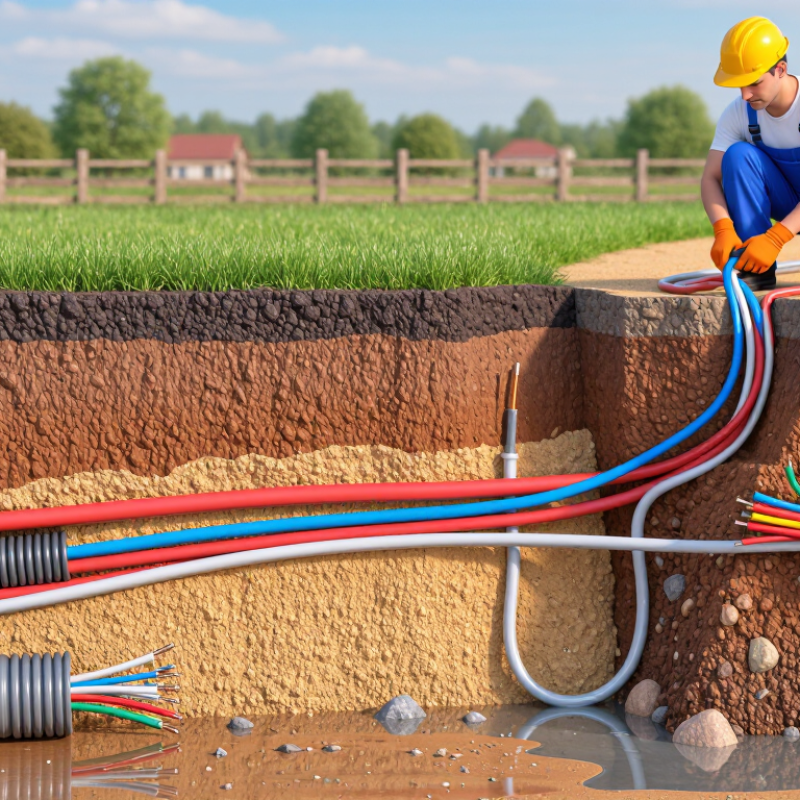
Direct burial wire is an insulated electrical cable designed for underground installation without continuous conduit. Its jacket resists moisture, soil contact, sunlight, and temperature changes. Ordinary Indoor Wire can absorb water and fail underground. That failure may stay hidden until lights flicker or a circuit stops working.
Direct Burial Low Voltage Wire is commonly used for garden lighting, pathway lamps, outdoor sensors, gate controls, and small irrigation systems. It usually contains copper conductors with a durable, water-resistant jacket. Choose the wire size according to the system’s load and cable length. Long runs need thicker conductors because voltage drop can reduce brightness and performance. Small details matter.
A shallow trench may look harmless. It is not.
Burial depth depends on local electrical rules, installation conditions, and the circuit type. Check the cable marking before purchase, then confirm requirements with a qualified electrician or local authority. Use suitable connectors rated for wet locations. Protect the cable where it rises near walls, posts, or walkways, because lawn equipment can cut exposed sections.
One practical mistake is treating “direct burial” as a guarantee against every problem. It is only one part of a safe installation. Soil movement, sharp rocks, poor drainage, and overloaded circuits still create risks. I would leave extra cable at connection points, although too much slack can invite careless damage. Careful planning often matters more than choosing the most expensive insulation.
Key Standards and Safety Requirements for Direct Burial Wire in 2026
In 2026, the best direct burial wire is not chosen by size alone. Its insulation, listing, burial depth, and installation environment matter equally. The 2023 National Electrical Code, Article 300.5, requires underground wiring to use approved wiring methods and suitable protection. Some residential circuits may require 18 inches of cover with GFCI protection, while other installations need 24 inches or more. Local amendments can change these values.
For a 2 2 2 4 Direct Burial Wire installation, confirm the conductor material, voltage rating, temperature rating, and approved use. A cable marked only for underground use may not be acceptable inside a building. USE-2 conductors, for example, may need an additional rating before entering interior spaces. Independent certification should match the applicable product standard. The 2023 NFPA report on U.S. fire losses recorded about 27,700 home fires involving electrical distribution and lighting equipment. That number makes small installation shortcuts feel less harmless.
Tips: Check the marking before purchase. Use a depth gauge, not guesswork. Keep splices inside listed underground enclosures. Add warning tape above the cable. Take photos before backfilling. I have seen careful layouts fail because sharp stones damaged insulation during burial. A final inspection can still miss hidden damage, so testing insulation and continuity is worth the extra minute.
Comparing Copper and Aluminum Direct Burial Conductors
Choosing direct burial wire in 2026 starts with conductor metal, not a catchy product label. NFPA 70, 2023 edition, requires listed conductors and suitable wet-location protection for underground installations. Soil stays damp, even when the trench looks dry. Many field failures begin at terminations, not along the buried cable.
At 20°C, IEC 60228 reference values place copper resistivity near 17.2 nΩ·m and aluminum near 28.3 nΩ·m. Copper therefore produces less voltage drop at the same cross-sectional area. Aluminum weighs far less. That can simplify long pulls, but it usually needs a larger conductor for equal performance. UL 486B addresses aluminum and copper-aluminum terminations, including preparation and connector compatibility. Do not treat any lug as universal.
The USGS Mineral Commodity Summaries 2025 reports approximately 1.1 million metric tons of U.S. copper mine output in 2024. It reports roughly 670,000 tons of primary aluminum production. These figures describe supply, not cable quality. For a 4 3 Wire Direct Burial installation, compare voltage drop, burial listing, conductor size, and termination instructions. Site length changes the answer. Copper feels forgiving during installation. Aluminum can be sensible on long feeders, yet rushed preparation creates avoidable resistance. Real trenches are less tidy than planning tables suggest. Verify the final design with a licensed electrician and the governing electrical code.
How Insulation Types Affect Burial Performance and Service Life
What Is the Best Type of Direct Burial Wire in 2026?
How Insulation Types Affect Burial Performance and Service Life
Direct burial performance depends more on insulation than appearance. Polyvinyl chloride insulation handles moisture reasonably well, but it can stiffen in cold soil. Cross-linked polyethylene remains more stable across temperature changes. XHHW-2 and USE-2 conductors commonly carry 90°C ratings in wet or dry locations, according to UL 44 and UL 854 requirements. That rating matters when summer soil temperatures rise around a loaded cable.
Moisture is the hidden problem. An EPRI underground cable aging review identifies water-related insulation deterioration as a major cause of long-term failure. XLPE resists water absorption better than many basic thermoplastic compounds. It also tolerates repeated heating and cooling cycles. Still, “water-resistant” does not mean damage-proof. Sharp stones, tight bends, and poor trench bedding can weaken insulation before energizing.
Depth matters too. The 2023 National Electrical Code tables set burial requirements based on circuit type, location, and protection method. Insulation alone cannot replace correct installation. In field work, I have seen excellent cable fail beside crushed conduit and careless backfill. That is an uncomfortable reminder: the best insulation can still lose to bad preparation. Testing insulation resistance before backfilling provides useful evidence, although one test cannot predict every future fault.
What Is the Best Type of Direct Burial Wire in 2026? - How Insulation Types Affect Burial Performance and Service Life
| Insulation Type | Typical Continuous Conductor Rating | Wet-Location Capability | Moisture Resistance | Mechanical Performance | Typical Burial Performance | Service-Life Outlook | Best-Fit Applications |
| PVC | Typically 75°C wet / 90°C dry, depending on the listed construction | Good when specifically marked for wet locations | Good; vulnerable to long-term water and chemical exposure if the formulation is not suitable | Good abrasion resistance; can become less flexible in cold conditions | Good in prepared trenches with adequate cover and protection from sharp backfill | Good under controlled temperature, moisture, and chemical conditions | General-purpose residential, agricultural, and light commercial burial installations |
| XLPE | Typically 90°C wet and dry for constructions listed for these conditions | Excellent when the cable carries the appropriate wet-location marking | Very good; low water absorption and strong resistance to moisture-related degradation | Very good thermal and abrasion performance; installation bending limits must be followed | Excellent for long runs, higher loads, and installations exposed to temperature variation | Very good when protected from excessive heat, chemicals, and physical damage | High-load feeders, renewable-energy circuits, outdoor equipment, and demanding underground routes |
| EPR | Commonly 90°C wet and dry; exact ratings depend on the cable construction | Excellent for appropriately listed wet-location cables | Excellent; maintains electrical properties well in damp and wet environments | Very good flexibility and resilience; may require larger cable dimensions | Excellent where flexibility, moisture exposure, and thermal cycling are major concerns | Very good to excellent when correctly specified and installed | Industrial feeders, wet soil, areas with thermal cycling, and applications requiring flexible insulation |
| Polyethylene (PE/HDPE) | Often lower than XLPE or EPR; use the temperature rating printed on the cable | Generally very good when the complete cable assembly is listed for wet locations | Excellent water resistance and low moisture absorption | Good impact and abrasion resistance; ultraviolet exposure requires suitable protection | Very good in wet soil and conduit systems, subject to thermal limitations | Good to very good when temperature loading remains within the design rating | Moisture-prone soil, underground communications or power systems, and conduit applications |
| Thermoplastic Elastomer (TPE) | Commonly 75°C to 90°C, depending on the formulation and listing | Good to excellent when specifically approved for wet burial | Good to excellent; performance varies substantially by formulation | Excellent flexibility and resistance to repeated movement or vibration | Good for difficult routing, vibration, and movement when the cable is listed for burial | Good when chemical compatibility and temperature limits are verified | Flexible outdoor equipment connections and installations subject to vibration or movement |
Selection note: The best direct-burial wire is the complete cable assembly—not insulation material alone. Verify the cable’s marking for direct burial or wet-location use, conductor temperature rating, voltage rating, sunlight exposure, chemical compatibility, minimum burial depth, grounding method, and local electrical-code requirements. Actual service life depends heavily on installation quality, soil conditions, operating temperature, water exposure, and protection from physical damage.
Choosing the Best Wire Gauge for Load, Distance, and Voltage Drop
Choosing the best Direct Burial Power Wire starts with the load, not the trench. Check the equipment’s running watts, starting current, and voltage rating. A pump may draw modest power while running, then demand much more during startup. That brief surge can expose an undersized cable.
Wire gauge matters because lower AWG numbers indicate thicker conductors. For a short, lightly loaded circuit, 12 AWG may be suitable. Longer runs often require 10 AWG, 8 AWG, or larger conductors. Do not choose by distance alone. Calculate voltage drop using the full circuit length, including the outgoing and return paths. Many professionals aim for about 3% drop on a branch circuit, while keeping total drop near 5%. These figures are useful guides, not replacements for local requirements.
Copper usually carries the same load with a smaller conductor than aluminum. Aluminum can still work when properly sized and terminated. Check insulation markings for direct-burial and wet-location approval. Soil stays damp, even when the surface looks dry. I also prefer mapping the route before digging and allowing extra length at junction points. That small detail prevents strained connections later.
My own weak point is trusting a simple online calculator too quickly. It may ignore motor startup, ambient temperature, or bundled cables. Recheck the result against equipment instructions and applicable electrical rules. When the load is uncertain, sizing only for normal operation can create a warm cable and disappointing performance.
What Is the Best Type of Direct Burial Wire in 2026?
For direct-burial applications, use copper conductors with insulation specifically approved for underground burial, such as USE-2, RHW-2, or XHHW-2. The chart compares the estimated maximum one-way distance for a 20-amp, 120-volt load while keeping voltage drop near the recommended 3% limit.
Assumptions: copper conductors, 120 V single-phase circuit, 20 A load, 3% maximum voltage drop, 75°C conductor resistance, and one-way distance with equal-length hot and return conductors. Ampacity values are typical 75°C reference values; final wire selection must also account for insulation rating, burial depth, conduit fill, ambient temperature, terminal ratings, and local electrical code requirements.
Environmental Factors That Determine the Right Burial Wire
What Is the Best Type of Direct Burial Wire in 2026?
Environmental Factors That Determine the Right Burial Wire
The best direct burial wire depends on soil, moisture, temperature, and mechanical exposure. Wet or poorly drained soil increases corrosion risk at connections. The USDA NRCS Web Soil Survey identifies drainage classes, texture, and seasonal water tables for local sites. Check those details before choosing insulation. Clay soil holds water longer than sandy soil. That difference matters.
Flooding deserves more attention in 2026. NOAA recorded 27 separate billion-dollar weather and climate disasters in the United States during 2024. Buried wiring may face saturated soil, shifting ground, and repeated freeze-thaw cycles. For these areas, use cable specifically listed for direct burial, with water-resistant insulation and protected junctions. Follow NFPA 70, 2023 edition, for burial methods and required cover. Depth can change with location, wiring method, and physical protection.
Soil chemistry can quietly damage a good installation. The ASTM G57 soil-resistivity method helps evaluate corrosive conditions, but testing is often skipped. That is a mistake. Copper conductors offer excellent conductivity, while aluminum can reduce weight and material cost. However, termination quality becomes more critical with aluminum. I would not call one conductor universally best. A site with acidic soil, irrigation, or road salt may need extra corrosion controls. Even accurate planning has limits. Local testing remains more reliable than a generic product chart.
A Practical Framework for Selecting Direct Burial Wire in 2026
What Is the Best Type of Direct Burial Wire in 2026?
Choosing direct burial wire starts with the installation, not the label. The best option is rated for wet locations and direct contact with soil. In many residential projects, a listed underground feeder cable is practical for feeding outdoor equipment or detached structures. Individual conductors inside approved conduit may offer better protection and easier future replacement. Do not use indoor-only cable underground. Moisture eventually finds weak points.
Check the expected load before choosing conductor size. Calculate continuous demand, starting current, distance, and voltage drop. A small pump may start smoothly on a short run but struggle at the end of a long trench. Copper often provides compact terminations, while aluminum can reduce material cost on larger feeders. Each requires correctly rated terminals and preparation. Details matter.
Burial depth, warning tape, conduit protection, and GFCI requirements depend on local rules and site conditions. Rocky soil, vehicle traffic, roots, and future landscaping can change the safer installation method. Use listed fittings and seal exposed entries against water. A qualified electrician should verify the current electrical code before work begins. Product markings can be confusing, and I would not trust a supplier’s short description alone. Read the certification, temperature rating, conductor size, and permitted applications. The “best” wire is the one that matches the load, environment, and installation method without forcing a compromise.
Conclusion
Direct Burial Wire is designed for safe, long-term installation underground without requiring a separate conduit in many approved applications. In 2026, selecting the right type means understanding current electrical standards, burial depth, grounding practices, moisture resistance, and protection from physical damage. Copper conductors generally provide excellent conductivity and flexibility, while aluminum can offer a lighter and more economical option when properly sized and terminated. Insulation quality is equally important, since different materials perform differently under moisture, temperature changes, soil exposure, and mechanical stress.
The best Direct Burial Wire should also match the circuit’s load, installation distance, and acceptable voltage drop. Larger gauges may be necessary for high-power equipment or long runs, while local soil conditions, flooding risk, freezing temperatures, sunlight exposure, and potential chemical contact can influence insulation selection. A practical decision should therefore combine conductor material, wire gauge, insulation type, environmental conditions, installation method, and applicable safety requirements to achieve reliable performance and a long service life.