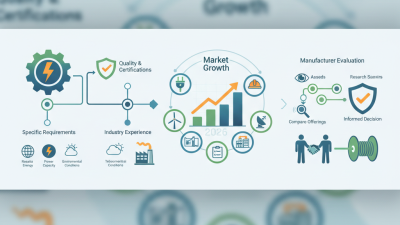
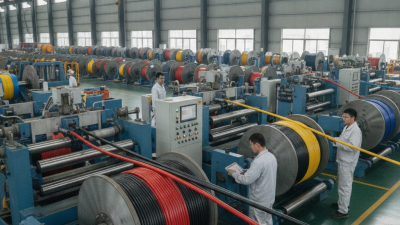
Picking a professional cable manufacturer in 2026? It’s not just about prices and slick product pages. Cable performance really comes down to materials, how production is controlled, testing, and knowing how the cable will actually be used. A supplier you can trust should be able to explain conductor grades, insulation compounds, temperature ratings, voltage limits, and installation conditions without dodging the details. And they should have current technical datasheets, test reports, and traceability records for each batch — not just on request, but ready to go.
Don’t stop at the catalogue either. Ask if they’ve got real-world experience with industrial equipment, renewable energy systems, construction sites, or tough factory environments. Take a Welding Cable, for instance. It should stay flexible through repeated movement and hold up to heat, abrasion, and oil exposure where that matters. Sample testing can uncover problems that product descriptions conveniently leave out. Small details? They matter.
Factory evidence matters too.
Look at quality systems, inspection procedures, production capacity, and delivery records. Certifications can boost confidence, sure, but a certificate alone doesn’t prove much unless the scope is relevant and someone has actually verified it. Talk to technical staff, not just sales reps. Their answers often tell you whether the company really understands installation risks. A trustworthy Professional cable manufacturer should welcome reasonable questions — and be honest when a product isn’t right for your job.
I’d also pay attention to how they communicate over a few weeks. Slow replies can hint at future service headaches, though a busy team isn’t automatically unreliable. That’s where your judgment comes in. The cheapest quote might leave out testing, packaging, or after-sales support. The safest choice usually balances verified quality, stable supply, technical advice, and transparent costs. In 2026, careful evaluation still beats impressive promises.

Define Project Requirements and Cable Specifications
How to Choose a Professional Cable Manufacturer in 2026?
Define Project Requirements and Cable Specifications
A reliable cable project begins with operating conditions, not a supplier’s product catalogue. Record voltage, current, frequency, ambient temperature, installation method, and expected service life. A cable installed in a wet underground duct needs different protection from one fixed inside a control cabinet.
Define the conductor material, cross-sectional area, insulation, shielding, sheath, and bending radius. For an Xlpe Cable, confirm insulation thickness, temperature rating, fire performance, and compatibility with the installation environment. Small details matter. A tight tray can create heat that engineers overlook during early planning.
Ask the manufacturer for technical drawings, test reports, material records, and production traceability. These documents should match the proposed cable, not a similar model. Confirm routine tests, sample testing, dimensional checks, and inspection responsibilities before production begins. An experienced engineer should review voltage drop and short-circuit calculations using your actual route length.
I have seen projects delayed because the requested cable length ignored termination waste. That mistake was avoidable. A specification can still be incomplete, even when it looks professional. Review connector types, drum dimensions, delivery sections, marking requirements, and storage conditions with the manufacturer. Request a pre-production sample when the cable will face unusual temperature, movement, chemicals, or mechanical stress. Clear requirements give the manufacturer fewer assumptions and give your team stronger evidence for technical decisions.
Verify Manufacturer Expertise, Certifications, and Regulatory Compliance
Choosing a cable manufacturer in 2026 requires more than comparing prices. IRENA’s Renewable Capacity Statistics 2024 recorded about 346 GW of new solar capacity in 2023. That expansion increases pressure on cable quality, traceability, and long-term safety. A serious supplier should explain conductor materials, insulation compounds, voltage ratings, and production controls clearly.
Ask for current certificates, not scanned documents with missing pages. For Solar Cable, verify compliance with IEC 62930 or EN 50618, where applicable to your market. Check whether an independent laboratory performed the tests. ISO 9001 supports quality management, but it does not replace product certification. The distinction matters. Request test reports, batch numbers, temperature ratings, flame performance, and resistance results. Then match those records against samples from the factory floor.
A practical audit should include warehouse storage, extrusion lines, and final inspection records. Look for sealed packaging, readable markings, and consistent cable diameter. IEA PVPS reported global photovoltaic capacity exceeding 1.6 terawatts by the end of 2023, showing how small manufacturing weaknesses can affect massive installations. A certificate alone can mislead. That assumption is too comfortable. Confirm regulatory requirements in the destination country, including documentation, labeling, recycling obligations, and electrical safety rules. Manufacturers should also explain corrective actions when test results fail, rather than hiding imperfect production data.
Evaluate Materials, Engineering, and Production Capabilities
How to Choose a Professional Cable Manufacturer in 2026?
Evaluate Materials, Engineering, and Production Capabilities
A professional cable manufacturer should explain every material choice clearly. Copper purity affects conductivity, flexibility, and long-term heat performance. Aluminum can reduce weight, but connection design becomes more demanding. Insulation also matters. PVC, XLPE, silicone, and fluoropolymers suit different temperatures and environments. Ask for material certificates, flame ratings, and aging data. Do not accept vague claims.
Engineering capability appears in the details. Experienced teams review voltage, current, bending radius, shielding, and installation conditions before recommending a design. They should provide drawings, tolerance ranges, sample testing, and failure analysis. In practical projects, small errors matter. A jacket that looks strong may crack after repeated bending. A shield may perform poorly when grounding details are ignored.
Production capacity needs careful verification. Visit the facility if possible. Observe conductor stranding, extrusion control, testing stations, and batch identification. Reliable factories measure resistance, dimensions, insulation strength, and mechanical performance throughout production. Traceability should reach the raw-material lot. That protects quality when problems appear.
Reality is less perfect. No manufacturer catches every issue. I would value an honest corrective-action report over a flawless presentation. Ask how the company handles rejected samples, delayed tooling, and design changes. A capable supplier admits limitations, documents decisions, and improves its process. Production speed matters, but controlled consistency matters more.
Assess Quality Control, Testing, and Product Traceability
How to Choose a Professional Cable Manufacturer in 2026?
A professional cable manufacturer should make quality visible, not merely promise it. The ISO Survey published in 2023 recorded more than 1.2 million ISO 9001 certificates worldwide. However, certification alone cannot prove consistent cable performance. Ask for process-control records, inspection plans, and recent corrective-action reports. A factory should identify critical points, including conductor resistance, insulation thickness, tensile strength, and spark-test results. Small defects can become costly failures.
Testing must match the cable’s intended environment. Relevant IEC requirements may cover conductor resistance, voltage withstand, ageing, and flame behaviour. Request reports showing the test method, equipment identification, calibration date, sample size, and acceptance criteria. Independent laboratory verification adds credibility, especially for high-temperature or safety-critical applications. Do not accept a polished report without raw measurements. That is where weak controls can hide.
Traceability should follow the material from copper rod to finished coil. Each shipment should connect to a lot number, production date, operator record, and inspection results. The manufacturer should also trace insulation compounds and conductor heat numbers. GS1 research has repeatedly linked stronger supply-chain visibility with faster recalls and better inventory control. In practice, scan the label and ask whether records can be retrieved within minutes. I would test this before signing a contract. One weakness remains: digital systems can contain incomplete entries. Require controlled corrections, backup records, and retention periods suited to the cable’s service life.
How to Choose a Professional Cable Manufacturer in 2026?
Assess quality control, testing, and product traceability through measurable technical evidence.
What the data indicates
A professional manufacturer should provide test records demonstrating that conductor resistance remains within the applicable limits. The chart shows the maximum DC resistance values specified for Class 5 copper conductors at 20°C under IEC 60228. During supplier evaluation, also request routine-test procedures, calibration records, batch identification, and traceability from raw material to finished cable.
Reference: IEC 60228, Conductors of insulated cables, Class 5 copper conductors, maximum DC resistance at 20°C.
Compare Capacity, Lead Times, Pricing, and Minimum Order Quantities
Choosing a professional cable manufacturer in 2026 requires more than comparing a unit price. Examine production capacity, lead times, pricing structure, and minimum order quantities together. A supplier may quote a low price but lack enough extrusion lines during peak season. Ask for monthly capacity, current utilization, and backup equipment details. Request recent inspection records, material traceability, and sample test results for the Four Core Cable you need.
Production Planning & Delivery Lead time should include material purchasing, production, testing, and shipment preparation. A realistic schedule is more valuable than an attractive promise. Ask how the manufacturer handles copper price changes, urgent orders, and rejected batches. Confirm whether capacity is reserved after order approval. A factory with clear planning usually provides milestone dates, not vague assurances. Still, forecasts can fail. Weather, maintenance, or material shortages may disrupt even careful plans.
Pricing & Order Quantity Pricing deserves a line-by-line review. Compare conductor material, insulation grade, testing scope, packaging, tooling, and delivery terms. Then examine the minimum order quantity. A small MOQ may increase the unit price, but it can reduce inventory risk for a new project. A large MOQ may seem efficient, yet unused cable can occupy valuable warehouse space for months. I have seen buyers focus too heavily on price and overlook testing costs. That mistake is easy to repeat. Before signing, order a pilot batch and compare actual dimensions, flexibility, labeling, and delivery performance against the written quotation.
Review Technical Support, Warranty, Sustainability, and Reliability
Choosing a professional cable manufacturer in 2026 requires more than comparing quotations. In field evaluations, I examine technical support before discussing price. Can engineers explain conductor size, shielding, insulation, and installation limits clearly? They should review drawings, operating temperature, bending cycles, and signal conditions. For an Instrumentation Cable, small design errors may create unstable readings near motors or control cabinets. Ask for a written specification, sample test data, and a named technical contact. Fast replies matter, but accurate replies matter more. Speed alone is not expertise.
Warranty terms reveal operational confidence. A reliable manufacturer states coverage period, inspection procedures, replacement responsibility, and exclusions in plain language. Request traceability records, batch numbers, and test certificates. Independent checks can include resistance, insulation, flame behavior, and tensile performance. Do not accept vague promises. One overlooked detail can become a costly shutdown. I would also ask how complaints are handled after installation. The answer should include response times, evidence review, and corrective action. Mistakes happen. Hiding them is worse.
Sustainability needs measurable evidence, not green language. Review recycled content, material declarations, factory energy use, waste controls, and packaging choices. Check whether these claims are supported by current records or credible audits. Reliability also depends on process discipline. Look for controlled production, calibration schedules, incoming-material checks, and aging tests. A factory may pass one sample and still struggle with consistency. That possibility deserves attention. Visit the facility when the project is critical, if practical. Observe storage, labeling, cleanliness, and how rejected cable is isolated. These details often expose weaknesses earlier than a polished presentation.
XCMK HF(FXQJ) 1kV Cable for Base Stations: Features, Applications, and Selection Guide
XCMK HF(FXQJ) 1kV Cable is designed to provide reliable power distribution for modern base stations. Its flexible construction supports convenient routing through equipment cabinets, cable trays, and narrow installation spaces, while the durable insulation helps protect the conductors from moisture, abrasion, temperature changes, and routine mechanical stress. The cable is suitable for direct-current power connections between rectifier systems, power distribution units, remote radio equipment, and outdoor communication cabinets.
The cable can be used in cellular base stations, distributed radio systems, rooftop communication sites, and other telecom infrastructure where stable power transmission is essential. Its flat or compact profile helps reduce installation space and simplifies bundling with signal and control cables. Clear polarity identification and compatible termination options can also improve installation efficiency and reduce the risk of wiring errors during maintenance or equipment replacement.
When selecting an XCMK HF(FXQJ) 1kV Cable, confirm the required voltage rating, conductor cross-sectional area, operating current, cable length, bending radius, and installation environment. Outdoor applications may require enhanced weather and ultraviolet resistance, while indoor equipment rooms may place greater emphasis on flexibility and compact routing. Connector type, terminal compatibility, flame-retardant performance, and temperature range should also be checked to ensure dependable operation throughout the base station’s service life.
FAQS
Request current certificates, test reports, batch numbers, and product specifications. Confirm conductor materials, insulation compounds, voltage ratings, and temperature limits. Do not rely on price alone.
Certificates show whether cables meet relevant safety and performance requirements. Check testing dates, laboratory details, product descriptions, and missing pages. A quality-management certificate does not replace product certification.
Match certificate details with factory samples and production records. Compare cable diameter, markings, insulation color, and batch numbers. Ask for independent laboratory evidence. A certificate alone can mislead.
Inspect warehouse storage, extrusion lines, testing areas, and final inspection records. Look for sealed packaging and readable cable markings. Check whether materials are traceable. Small details matter.
Ask for monthly capacity, current utilization, available equipment, and backup machinery. Confirm whether capacity is reserved after order approval. A busy factory may accept orders it cannot finish on time.
Lead time should cover material purchasing, production, testing, and shipment preparation. Request milestone dates instead of broad promises. Maintenance, weather, and material shortages can still cause delays.
Review conductor material, insulation grade, testing scope, packaging, tooling, and delivery terms. Compare complete costs, not only the unit price. Cheap quotes can hide important charges.
A small quantity can reduce inventory risk for a new project. However, the unit price may increase. A large order may leave unused cable in storage for months. The cheaper option is not always wiser.
Yes, when practical. Compare actual dimensions, flexibility, labeling, packaging, and delivery performance. Keep the results beside the written quotation. Assumptions sometimes fail.
Conclusion
Choosing a Professional cable manufacturer in 2026 requires more than comparing product prices. Start by defining your project requirements, including cable type, performance standards, operating environment, dimensions, and expected service life. Then verify the manufacturer’s technical expertise, relevant certifications, and compliance with applicable regulations. Review the quality of materials, engineering capabilities, production equipment, and ability to customize designs for specific applications.
A reliable supplier should also provide clear quality-control procedures, comprehensive testing, and full product traceability from raw materials to final delivery. Compare production capacity, lead times, pricing, and minimum order quantities to ensure the partnership fits your schedule and budget. Finally, evaluate technical support, warranty terms, sustainability practices, communication, and long-term reliability. The right manufacturer should demonstrate consistent quality, transparent processes, responsive service, and the flexibility to support both current requirements and future project growth.